
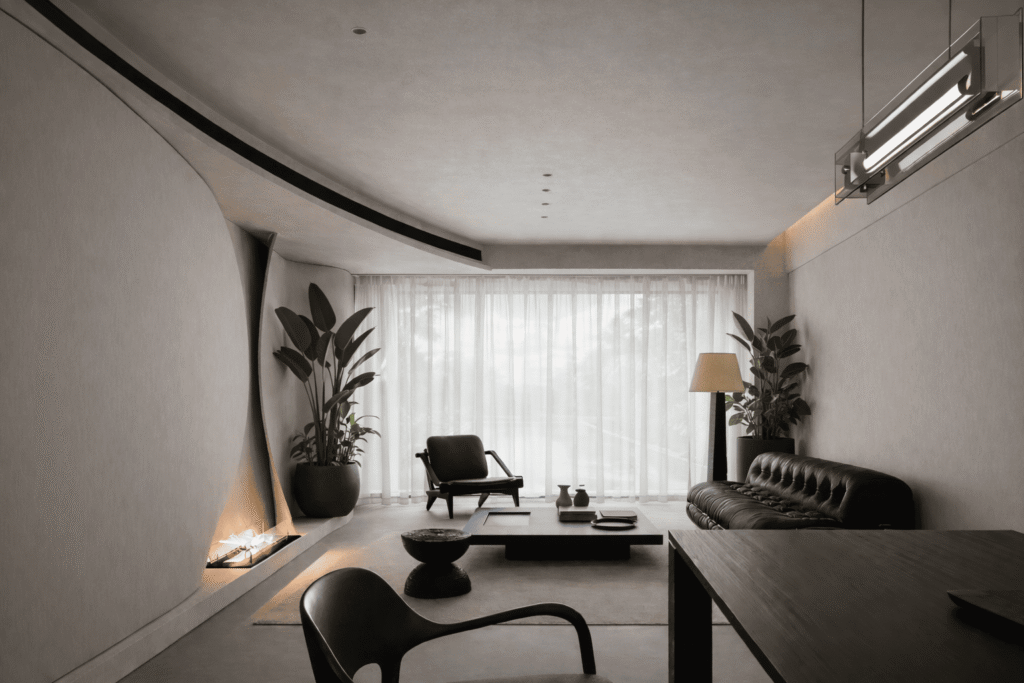
The Refined Art of Subtraction
Deepening sensory engagement and spatial appreciation; inducing the parasympathetic nervous system and staying anchored through the philosophy of subtraction.
Let’s begin with an uncomfortable truth.
Much of what is currently celebrated as spatial opulence in Nigeria’s high-end hospitality and residential real estate is all but opulent. It is excess disguised as luxury, noise dressed up in marble and stimulation mistaken for sophistication.
I have been privileged to experience many homes, hotels and restaurants regarded to be “premium” and one thing I find to be replete across nearly all of such spaces is visual, textural and acoustic assault.
Everything is calling for your attention all at once!
Feature walls scream in competition. Lighting schemes fold seamlessly into each other. Materials stack endlessly: marble on brass on glass on leather on gold- like an endless tug-of-war, all fighting to be noticed at once. The space just performs…… literarily, endlessly. And yet, after the initial awe fades, something quietly unsettling remains: you don’t feel rested. You don’t feel grounded and surely don’t feel restored.
This manifesto is a defiant objection to the prevailing assumption that more equals better in high-end space-making. It argues instead that thoughtful spatial design—rooted in subtraction, restraint, and intentionality—is one of the most powerful tools we have to reduce neuro-sensory overload and return the human body to a state of physiological and psychological calm.
The Cost of Sensory Excess
We are living in the most overstimulated era of human history.
Screens glow endlessly. Notifications interrupt relentlessly. Information bombards us from every direction. Stillness is now often unfamiliar and has now become an effortful act. Silence now feels unfamiliar and empty space feels uncomfortable. Somehow, our senses have been trained and made accustomed to being constantly stimulated.
In this context, the role of architecture and interior design has fundamentally shifted. Spaces are no longer just places to exist; they have become either sanctuaries from excitement and anxiety—or extensions of the same chaos we are trying to escape. Yet, many high-end spaces today mirror the external world’s overload instead of counterbalancing it. They multiply touchpoints: dramatic ceilings, layered lighting scenes, aggressive artwork, statement furniture, bold textures—often all within a single visual frame.
Neuroscience tells us that the brain does not experience these elements in isolation. Every competing stimulus demands processing. The result is cognitive fatigue, reduced attention span, and a subtle but persistent sense of restlessness. In trying to impress, these spaces exhaust; and this is where subtractive design comes in.
Subtractive Design Is Not Absence—It Is Precision
Misconceived as mere minimalism, emptiness, austerity or lack of vim, what this approach to design philosophizes is that every single element, feature or detail in a space MUST be intentionally chosen, planned and strategically located because it serves a purpose (tangible or intrinsic) and DESERVES to remain. When you remove the non-essential, what’s left gains power.
A single textured wall becomes tactile poetry when it is not competing with five others. A restrained lighting strategy allows the circadian rhythm to recalibrate. Negative space gives the eye—and the nervous system—room to breathe. This is where the paradox lies: subtractive design does not reduce neuro-stimulation; it deepens it.
Instead of rapid-fire sensory bombardment, the space delivers fewer stimuli with greater intentionality. The brain engages more slowly, more fully. Appreciation stretches over time and impact lingers much longer. This is why spaces designed with restraint age better. They reveal themselves gradually. They don’t beg for attention—they earn it.
The Body Always Knows
True spatial success is not measured by Instagram engagement or immediate awe. It is measured by how the body responds when no one is watching.
Does it inspire your shoulders to drop in relaxation? Does your breathing slow? Do you feel anchored in your body rather than suspended in mental noise. Does it give you deeper cognitive clarity and grant you better internal cohesion?
Spaces that truly work, physiologically, are grounding. They create a sense of “arrival” not through spectacle, but through coherence. Materials feel honest, transitions are gentle and when not, strategically employed very conservatively. Sound is absorbed rather than amplified and lighting behaves more predictably. These are not aesthetic decisions. They are neurological ones.
When a space is curated rather than cluttered, the nervous system stops scanning for threats. The parasympathetic response activates and true rest- that one that feels like a nice cuddle in the cradle- becomes possible.
That is true luxury in its most evolved form.
Ancient Wisdom We Keep Ignoring
This truth is not new. It has simply been drowned out by spectacle. Across cultures and centuries, spatial wisdom has always mostly pointed toward restraint. The Japanese concept of Ma speaks to the power of the interval—the space between things. It recognizes emptiness not as void, but as an active element that gives form meaning. Space can be compelling in its seeming austerity. Le Corbusier’s modernist declaration that “less is more” was never about visual minimalism alone. It was about clarity. About removing noise so that structure, proportion, and human experience could take center stage.
It is critical to note that this is not a proposition of the superiority of one design ‘style’ or ‘era’ over another; it is simply a call to spatial adventure that is attuned with what the body and mind truly need to thrive.
Products and Properties That Prove the Point
The market has already validated subtractive design—we just don’t like to admit it.
Consider the iPhone versus many Samsung devices. One prioritizes restraint, intuitive hierarchy, and controlled user experience. The other often offers more features, more visual options, more stimulation. Yet one has achieved near-cultural reverence, not despite its simplicity, but because of it.
Or take Aman Resorts versus The Ritz-Carlton. Ritz-Carlton excels at grandeur, service layers, and visual richness. Aman, on the other hand, has built a cult following through silence, space, and understatement. Guests don’t just stay at Aman—they decompress there. Aman understands that in a world addicted to stimulation, subtraction becomes the ultimate indulgence.
A Call for Spatial Courage
Thoughtful spatial design requires courage—especially in markets where excess is equated with value. It takes confidence to leave a wall empty, discipline to limit materials, restraint to design for longevity rather than immediate applause. But the future of meaningful space-making lies here.
As the world grows louder, the most powerful spaces will be the quiet ones. As stimulation becomes unavoidable, the greatest luxury will be environments that ask less of us—not more.
This manifesto is not an argument against beauty, richness, or indulgence, rather, it is an argument for intentionality, for spaces that understand the human nervous system as deeply as they understand aesthetics becuse in the end, the most profound spatial experience is not the one that overwhelms you when you walk in—but the one that slowly brings you back to yourself.
And that kind of design does not add, it brutally subtracts!