
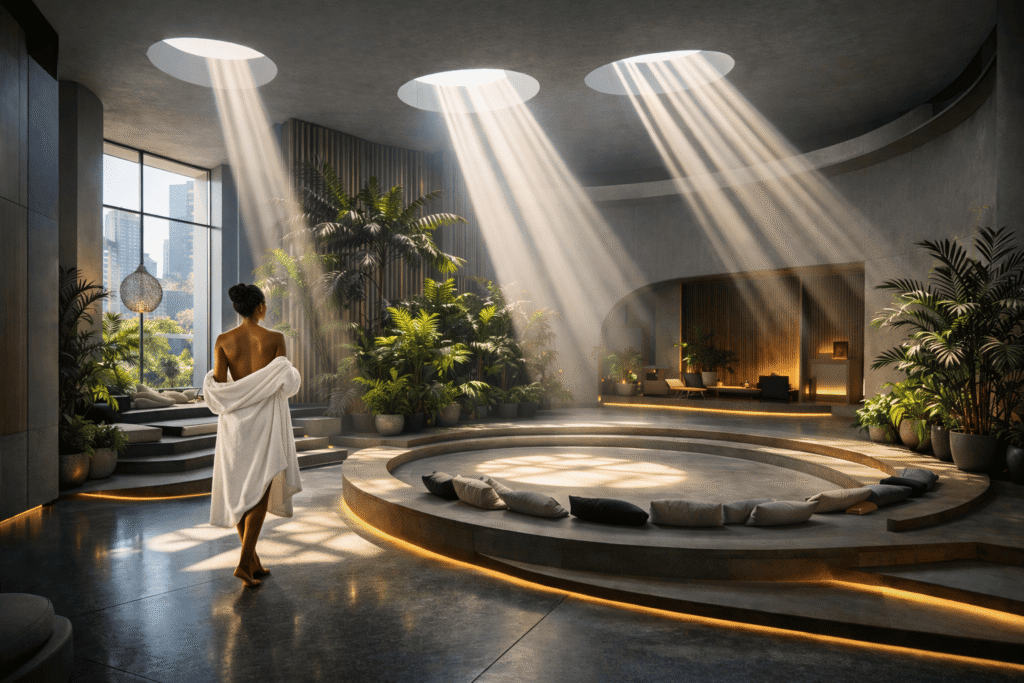
Lighting Is Not an Accessory
“… light has already defined the experience.”
Interior design does not begin with furniture, finishes, or colour palettes. It begins with light. Yet, across many design conversations—particularly within the African interior design context—lighting is often still treated as a supporting act, a decorative afterthought and something to be resolved once the “real design” is complete.
This belief is not just inaccurate; it is fundamentally at odds with how humans perceive space. Neuroscience confirms that the human brain processes brightness, contrast, and shadow before it interprets form, material, or colour. Long before a chair is admired or a texture is felt, light has already defined the experience.
Redefining Light Beyond Physics
“Light is that which defines.”
Science describes light as electromagnetic radiation within wavelengths visible to the human eye. While correct, this definition lacks spatial relevance. For designers, a more useful framing is this:
Light is that which defines.
It defines depth and edges, establishes hierarchy and focus and decides what is revealed—and what is allowed to disappear. Once light is understood as a defining force rather than a functional requirement, lighting design becomes more strategic than ornamental.
The Core Qualities That Shape Experience
Light influences space through several key qualities that directly impact human perception.
Intensity, measured in lux or lumens, affects visibility, alertness, and comfort. Research consistently shows that higher light levels support cognitive performance, while lower levels promote relaxation. This explains why overly bright bedrooms feel unsettling and underlit workspaces quietly fail their users.
Temperature, measured in Kelvin, shapes emotional response. Warmer temperatures (approximately 1800K–3000K) replicate dawn and dusk, triggering calm and intimacy. Cooler and less temperatures (5000K and above) resemble midday light, increasing alertness and precision. This is not a stylistic preference—it is rooted in human biology.
Sharpness determines how light sculpts space and form. Smaller light sources produce harder, more directional beams with crisp shadows, while larger sources create softer, diffused light. Crucially, intensity and sharpness operate independently: light can be soft yet powerful, or subtle yet dramatic.
When Knowledge Isn’t Enough
“The room had illumination, but no nuance.”
Even with a strong grasp of lighting principles, design can fail when hierarchy and layering is ignored. Early in my career, a residential project in a prime Lagos neighbourhood revealed this truth. The fixtures were well-chosen, calculations were accurate, but they and the execution was technically sound—yet the space felt unresolved.
The problem was control. Ambient, task, and accent lights were grouped under a single switch. The room had illumination, but no nuance. No emotional range. No ability to shift character and feeling.
Light existed—but it did not perform.
The Purpose of Layering Light
“The real power of layering lies in independent or strategically coordinated control”
Layered lighting is not about adding more fixtures. It is about creating spatially intelligent and resonant stories. Ambient lighting establishes overall legibility, task lighting supports function and is the precision. Accent lighting introduces narrative—guiding attention, sculpting form, and creating moments of intrigue while decorative lighting lighting should punctuate the design, not dominate it.
The real power of layering lies in independent or strategically cordinated control. When each layer can be adjusted separately, space becomes responsive rather static, morning differs from evening, productivityfrom intimacy and one same room can be designed to tell multiple stories with dynamism and charge.
A Question Worth Sitting With
If light defines space, then what are our spaces currently saying—unintentionally? Lighting design exists in the space between science and artistry, calculation and intuition. It is in this “in-between” that spatial theatre is born.
In the next part of this series, we will explore lighting levels, direction, and fixture selection—and how subtle shifts radically transform perception.
For now, consider this thought:
What if the most powerful spaces are not the most decorated, but the most intentionally lit?