
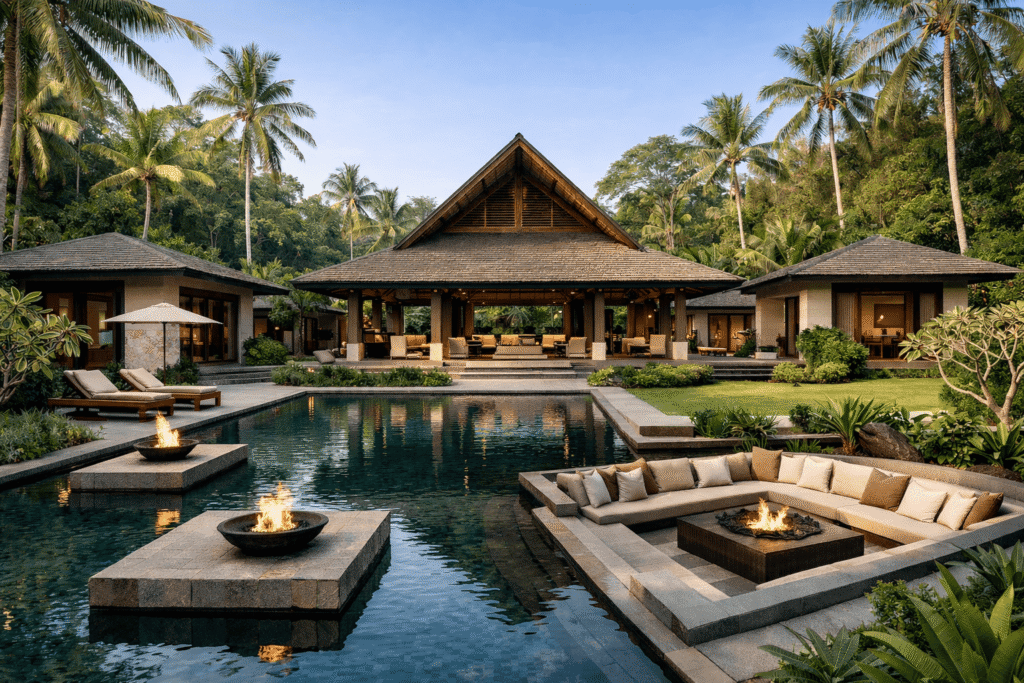
Longevity Architecture: The New Hallmark of Spatial Opulence!
The Redefinition of Prestige in the Built Environment
“….the built environment is an active biological interface of wellness.”
Prestigious living was once defined by visual opulence—rare materials, grand proportions and symbolic excess. Today, that definition is being fundamentally rewritten. True prestige is no longer performative but practical. The most valuable spaces are now those that demonstrably enhance physical restoration, cognitive clarity and long-term wellbeing.
This shift reflects a deeper societal recalibration. As high-net-worth individuals increasingly prioritise healthspan over mere lifespan, the built environment is being reassessed not as a static backdrop but as an active biological interface—one capable of either accelerating decline or extending vitality.
Demographic and Societal Forces Driving the Shift
The global population is ageing at an unprecedented rate, with adults over 60 projected to double by 2050. This demographic reality is reshaping expectations of living environments, particularly within premium residential, hospitality and private wellness contexts.
Longevity is no longer a medical ambition alone; it is a lifestyle objective. As healthcare increasingly shifts from treatment to prevention, architecture is being pulled into the conversation—not as an aesthetic exercise, but as a contributor to sustained autonomy, reduced morbidity and improved quality of life.
Empirical Evidence: How Space Alters Physiology
Scientific research now confirms what intuition long suggested: environments influence the body at a measurable level. Clinical studies have demonstrated that patients with access to natural views recover faster and require less pain medication than those in visually inert settings. Indoor air quality has been directly linked to cognitive performance, with optimised environments producing cognitive scores over 60% higher than conventional interiors—and more than double under high-performance conditions.
Even modest increases in indoor carbon dioxide levels have been shown to slow response times and reduce decision-making efficiency, underscoring how invisible environmental variables quietly shape daily performance.
Nature, Stress Reduction and Life Extension
“….spatial design is a slow but powerful determinant of health outcomes.”
Exposure to greenery is no longer viewed as a lifestyle preference; it is a public health variable. Large-scale analysis associate increased proximity to vegetation with a 4–7% reduction in all-cause mortality.
Beyond longevity, nature exposure consistently correlates with reductions in stress biomarkers, including measurable decreases in cortisol and systolic blood pressure. These effects, while seemingly incremental, compound over years—turning spatial design into a slow but powerful determinant of health outcomes.
Design Implications: From Intent to Measurable Outcomes
Longevity architecture demands an evidence-first design methodology. Design briefs must evolve beyond visual narratives to include quantifiable performance targets: indoor air quality thresholds, circadian lighting metrics, acoustic standards and daylight autonomy.
Biophilic design must shift from ornamental application to calibrated integration. Materiality, spatial sequencing, views and environmental rhythms must be deliberately composed to meet restorative thresholds proven to impact human wellbeing.
Environmental systems—ventilation, filtration, lighting and acoustic control—become foundational rather than auxiliary. In prestige living, these systems are no longer hidden infrastructure; they are value drivers.
Asset Value and the Economics of Restoration
“…increased occupant satisfaction translate into higher long-term asset value”.
From an investment standpoint, longevity-driven environments deliver measurable returns. Reduced healthcare costs, improved productivity, faster recovery times and increased occupant satisfaction translate into higher long-term asset value.
While certification frameworks such as WELL and Fitwel provide useful benchmarks, true prestige lies in bespoke, context-sensitive implementation rather than standardised compliance. Restoration, when designed with intention, becomes a competitive advantage.
Conclusion: The Future of Living Prestigiously
Longevity architecture is not a passing design philosophy—it is the next evolutionary standard. In the coming decade, the most desirable spaces will not be judged by how they impress at first glance, but by how consistently they restore. Luxury-living will belong to environments that quietly extend life, sharpen cognition and sustain vitality—spaces that do not merely house people, but actively make them better.